Leverage design thinking fundamentals to uncover your core values and set purpose-driven, actionable goals.

Design Thinking.
A mindset, a dogma, a way of living. Whatever you call it, the consultants (my folks), creators, and innovators of the world swear by it to solve complex, multi-dimensional problems. Despite our efforts to frame it as an elusive, abstract elixir to all of your CEO’s problems, design thinking is not complicated; however, it takes practice to effectively and intuitively apply its principles.
In my day-to-day, I often use design thinking to jolt creativity into helping clients identify, describe, and solve big organizational problems. Once we have our potential solutions, we iteratively vet them (defined below) to ensure we’re considering the impact these solutions will have on various client stakeholder groups. These groups usually the client’s customers, employees, or shareholders.
I recognize this use case is likely far removed from your day-to-day.
Thankfully, design thinking can be employed outside of the boardroom, by individuals, for some seriously inspirational results.
I’m going to show you how to use basic design thinking principles to define your personal core values.
You’ll finish this exercise with a unique set of 3–7 core values and hands-on experience applying basic design thinking principles and tools. I completed this exercise in December 2020 to uncover my core values. Photos of my personal process are included below to help guide you.
The final, optional step of this guide will explain how to take your core values a step further and use them to define new goals and validate pre-existing goals.
Why is this step optional?
Because core values are extremely useful beyond their applicability to goal setting. Ultimately, a value-driven life has many benefits such as reduced stress, a stronger sense of self, and improved decision making during major life milestones.¹
Whether you discover them in this exercise or you knew them in advance, share your list of core values as a response to this article. I’d love to see them!
Design Thinking Principles
Adapted from Accenture’s Five Key Elements of Design Thinking, here are three design thinking principles we’ll employ in the exercise: Human-Centricity, Fun, and Iteration.²
Human-Centricity
Understand Who You’re Designing For
Design thinking is design with humans in mind.
Effective design thinkers not only need to know who their end-users are, but they must also be able to empathize with them, deeply understanding their needs and their expectations for the end product or service to be delivered. A human-centric approach keeps designers honest. It replaces presumptive thoughts of “I think this is what they want” with evidence-based guardrails of “This is what they’ve told me they want”.
In this exercise, you, dear designer, are the end-user. Therefore you can skip the stakeholder interviews, the surveys, and other forms of primary research.
It’s easy and enticing to bias the process of identifying your personal core values thoughts of “what you should value” or “what you’re expected to value”. In exchange for not having to analyze piles of primary research data, I ask you to approach this exercise with curiosity, honesty, and self-compassion.
As best you can, leave external pressures at the door and start with an open mind. Be honest with yourself. With compassion, try to untangle your core values from the “values” imposed on you by others or by your environment.
Fun
Enjoy the Process
I love designing. It’s creative, it’s collaborative, and it’s in service of others. As an Experience Designer (not a typo), I have the privilege of creating spaces where clients are empowered to tackle their problems with a fresh approach. These are spaces where clients feel safe enough to share openly, build upon one another’s ideas, and think outside the box.
Initially, new participants may feel a bit apprehensive or skeptical. That’s completely reasonable considering how unique the experience is. Quite often, new session participants are shocked when they enter the workshop room or join the call. Music is playing, massive posters are on the walls, furniture has been pushed to the side, sticky notes are everywhere, and you best believe there will be food.
As time goes on, participants realize they are getting rewarded to hang with colleagues, draw tiny pictures (usually), and solve big problems. It’s a pretty sweet deal.
As you start these steps, the process may feel a bit weird. I encourage you to take a leap of faith and have fun with it! Play music! Move around! Call a friend! Have a glass of wine!
Do what feels good and lean into your creative self.
You’ll get the hang of it.
Iteration
Design, Test, Evaluate, Repeat
Design is a continuous process of cyclical refinement. In essence, it’s a condensed version of the scientific method: Define the problem to solve, generate hypotheses (designs) for how to solve the problem, test prototype solutions based on those hypotheses, and evaluate the effectiveness of those prototypes.
Even if the initial prototype solution solves the problem, don’t stop there. Push further. Reframe the problem and challenge the solution again and again. This might involve tweaking your existing prototype or starting again from scratch. Take the “Toyota 5 Whys” and replace it with the “Gwenna 50 What Ifs”.³
This core values exercise involves two formal iterations. Steps 3–7 are the first iteration and Steps 8–10 are the second.
Let’s get started!
Step 1: Grab Your Supplies
Design Thinking is a visual process. You’ll need the following for this exercise:
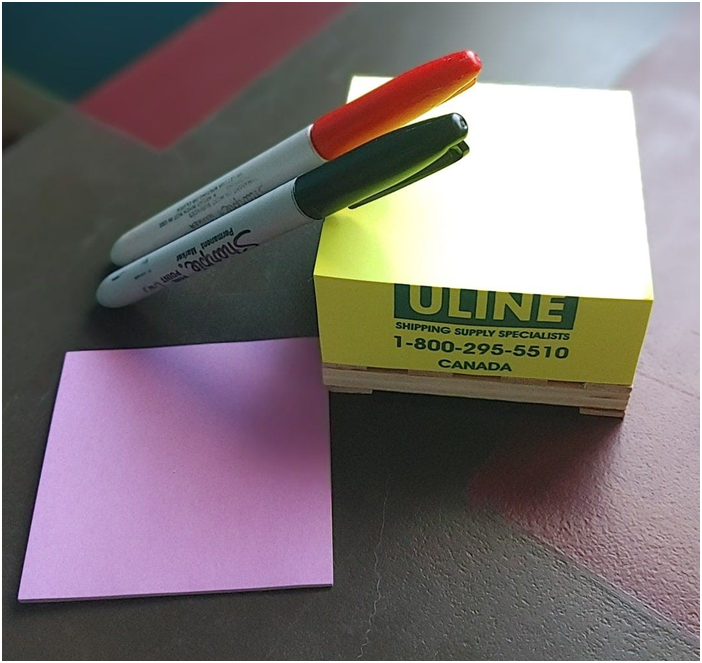
- 2 colours of permanent markers. One will be your “main” colour and the other will be your “highlight” colour. I chose black and red respectively.
- 2 colours of sticky notes. Again, one will be your “main” colour. You’ll want a stack of 50–100 sticky notes in your main colour. We’ll refer to the other colour as your “header” colour. You’ll want 5–10 sticky notes in this colour. I’ll show later why quality sticky notes — those with strong adhesive on a single side — are important. Step 4 is proof accordion-style sticky notes are the worst.
- A bare wall, preferably in your office or creative space.
- A reference list of 200+ core values in pdf or excel format. Try Scott Jeffrey’s list of 230 Core Values.⁴ If you’re a total completionist, here’s an alternative list of 500 Core Values from Threads Culture.⁵ 200+ core values may sound like a lot, but the vast majority will be gone before we reach Step 4.
- A sweet playlist for creativity and productivity. Try this one if you’re feeling low key.⁶
Step 2: Define your Themes
Decide which themes you will use to categorize your core values once you’ve shortlisted them. These themes should represent different facets of your life or how you spend your time and energy.
Keeping it simple, I pulled the following three themes from Danielle LaPorte’s Life Areas collection:⁷
- Livelihood & Lifestyle
- Body & Wellness
- Relationship & Society
Later steps in the exercise involve categorizing core values across these themes. To capture the core values that are relevant regardless of life area, add a fourth “Universal” theme.
Write each of your themes on a highlight colour sticky note. Spread them out on the wall.
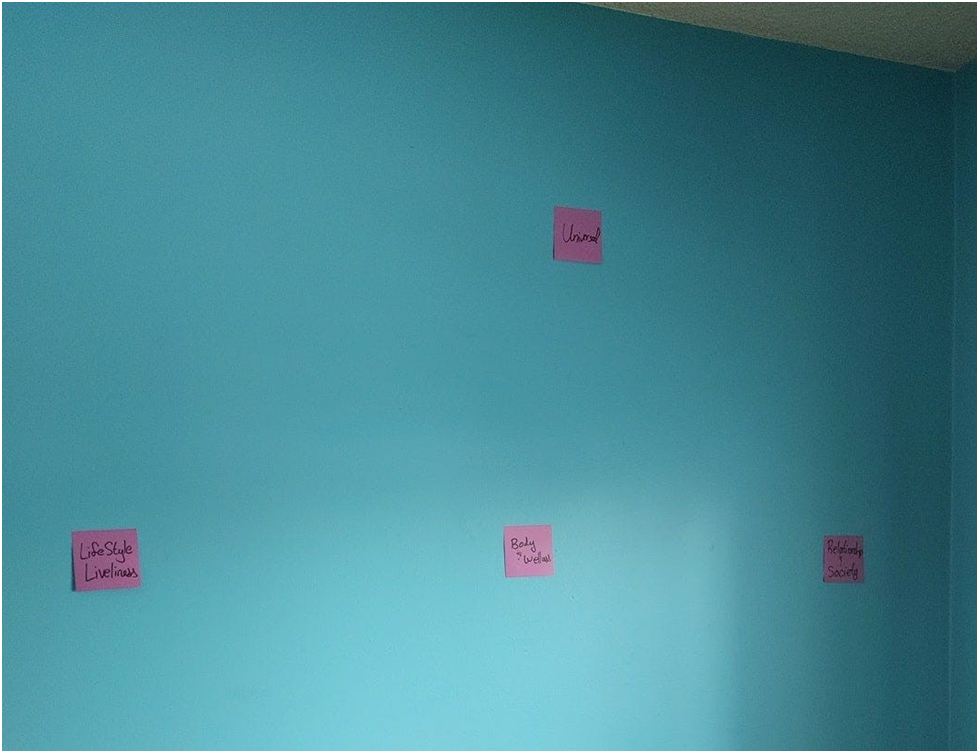
Write your themes onto sticky notes in your highlight colour and add them to the wall.
Step 3: Cut Down Your Reference List
Scan your list of core values and highlight/circle the core values that resonate. Don’t overthink this part. Trust your gut and try not to second guess yourself. If you highlight a core value and it later seems silly, don’t remove it. You selected it for a reason, so own it.
Read each core value out loud. This will slow your brain down and ensure you are taking the time to process every word.
Even a list of 230–500 core values isn’t comprehensive. If a core value isn’t on your list but comes to mind, note it. We’ll add it in future steps.
Once you’re done, don’t worry if it feels like you highlighted a lot of words. We’ll cut them down. I had ~60 words highlighted at this stage.
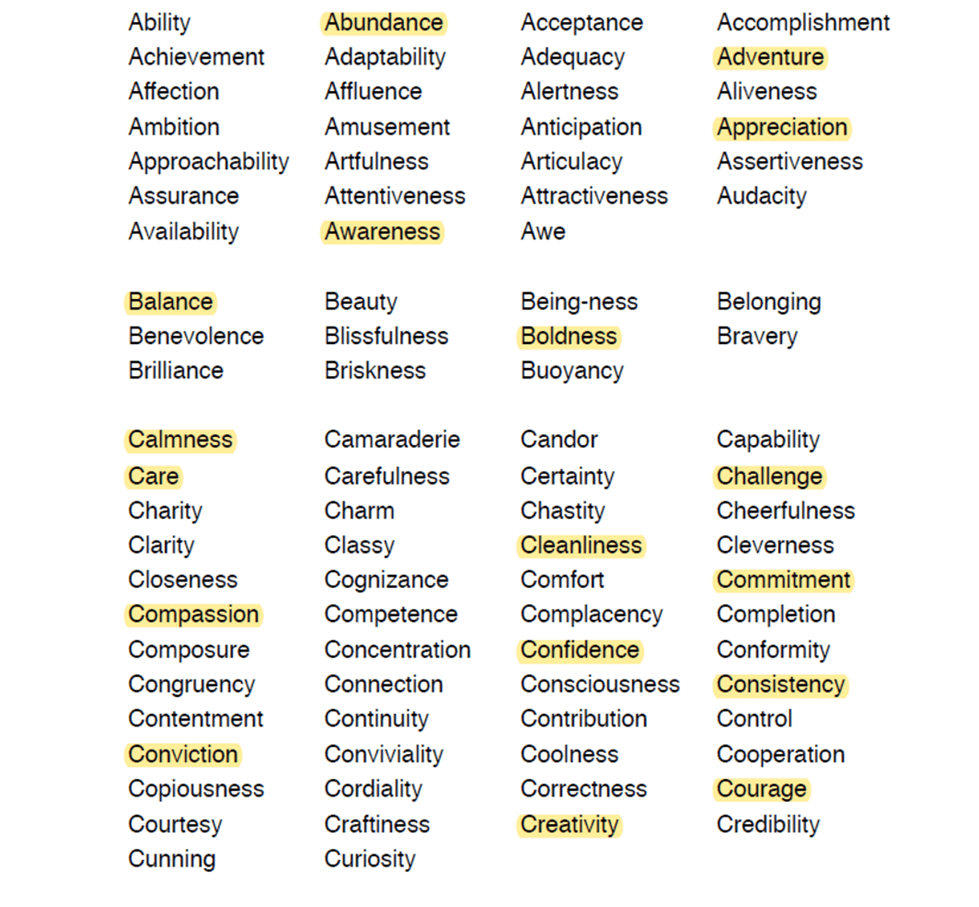
Highlight any core values on your list that resonate.
Step 4: Transcribe your List
Write each of your highlighted core values from Step 3 on sticky notes. Write one core value per sticky note. Use your main colour permanent marker and main colour sticky notes here.
Deep in your soul, you may feel the intense desire to tear the sticky off the stack once you’ve written on it. Unless you went rogue and used a pack of accordion-style sticky notes… Do not remove the sticky from the stack. Keeping them together will make your next step much faster.
Don’t forget any additional words you jotted down! If any more words come to mind, add them.
You’ll likely notice some of the words you selected are eerily similar. Keep the synonyms. It may feel redundant, but synonyms are a good thing. The repetition may indicate the significance of this core value to you.
Why didn’t we combine steps 3 & 4? Frankly, it’s faster. I’ll be the first to acknowledge this step is a bit slow, so go full assembly-line and power through it. Besides, you’re less likely to overthink your choices while completing short, repetitive tasks.
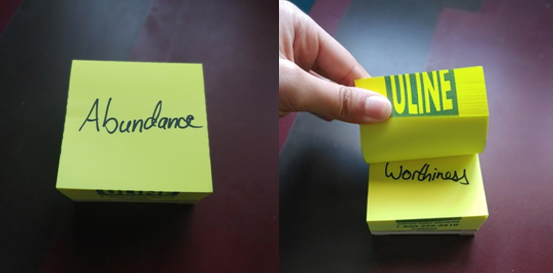
Transcribe your highlighted core values onto individual sticky notes. Keep your sticky notes in a single stack as you transcribe your highlighted core values.
Step 5: Organize Your Core Values by Theme
Now to the fun part! Sticky notes outlining your themes are already stuck to the wall (Step 2) and your uncontested stack of core value sticky notes are ready to go (Steps 3 & 4).
One-by-one, review your core value sticky notes and stick them on the wall under the theme each sticky is most relevant to.
If a core value applies to all themes, stick it under your Universal theme.
If a core value applies to multiple themes, but not all, write duplicate sticky notes and put a star in the top corner of the sticky so you know it’s a recurring core value. Stick each duplicate sticky note under the appropriate theme. As Step 4 stated, synonyms and duplicates are worth holding on to.
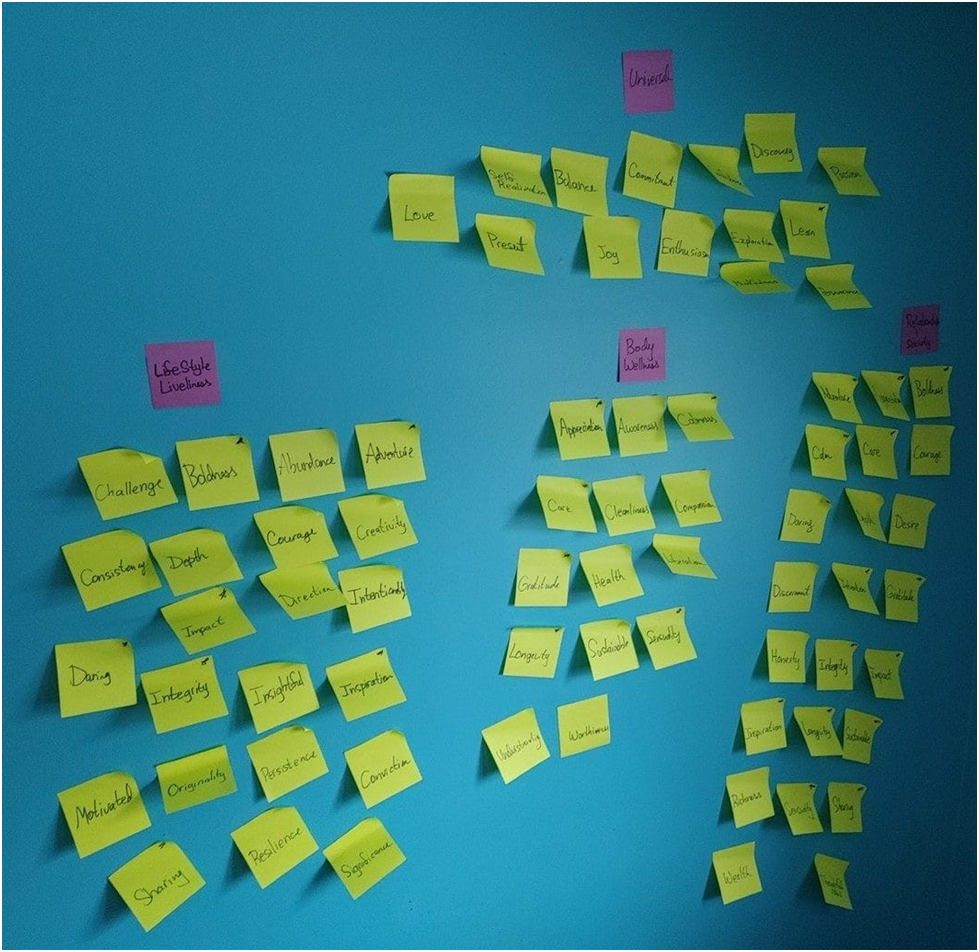
Organize your core values by theme. Create additional sticky notes for any core values that are relevant to multiple themes.
Step 6: Cluster
Let’s “cluster” (i.e. design thinking speak for categorization or segmentation).
Pick a theme and begin to sort the associated sticky notes.
This step is more an art than a science. Potential ways to cluster:
- By synonym.
- By application. For example, if you used the Relationship & Society theme, you can categorize based on what’s relevant to your romantic/sexual relationships vs. friendships vs. professional relationships vs. community relationships.
- By gut feel. Again, it’s an art, not a science.
Some core values may not play well with others. It’s completely fine. Keep these unclustered core values on the wall.
Repeat for each remaining theme.
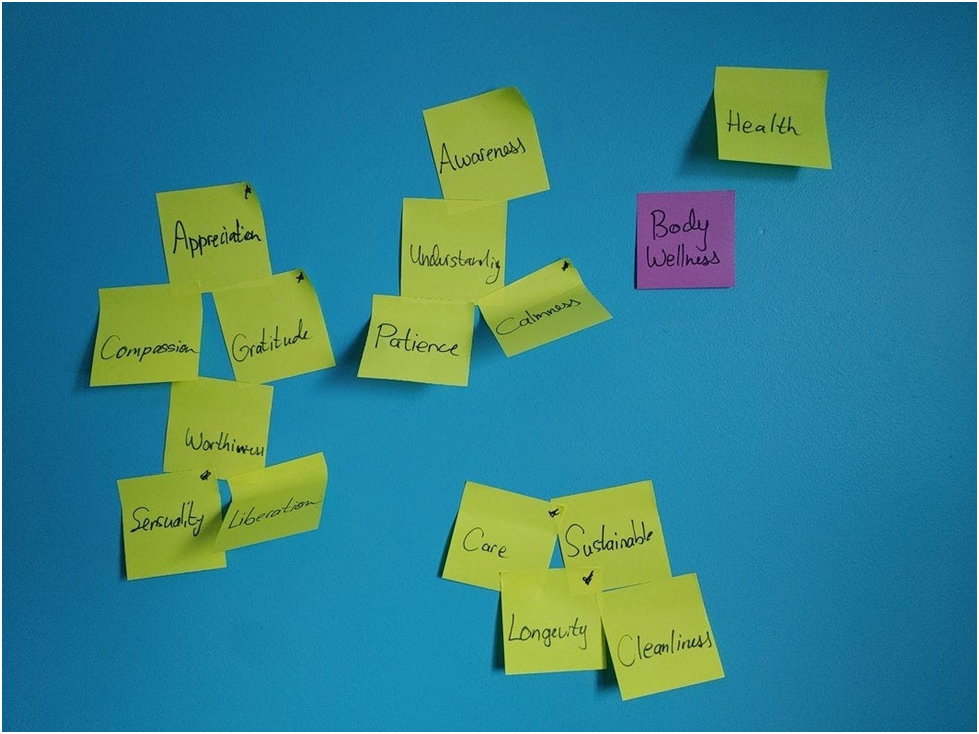
For each theme, review your core values and organize them into clusters. Some core themes may not cluster with others (i.e. “Health” in this image), keep them on the wall.
Step 7: Choose your Guiding Words
Think of guiding words as the titles or keywords for your clusters/theme.
Review your clusters and within each, look for guiding words. Circle these words with your highlight colour marker.
Not every cluster requires a guiding word. Additionally, your guiding words may come from your unclustered core values.
If you’re having trouble finding your guiding words, they may not be on the wall yet. You’re welcome to add those to the board using a main colour sticky note and your highlight colour marker.
I ended this step with 14 unique guiding words across my themes. Noticeably, the word “Intention”/”Intentionality” was a guiding word in 3 of my 4 themes.
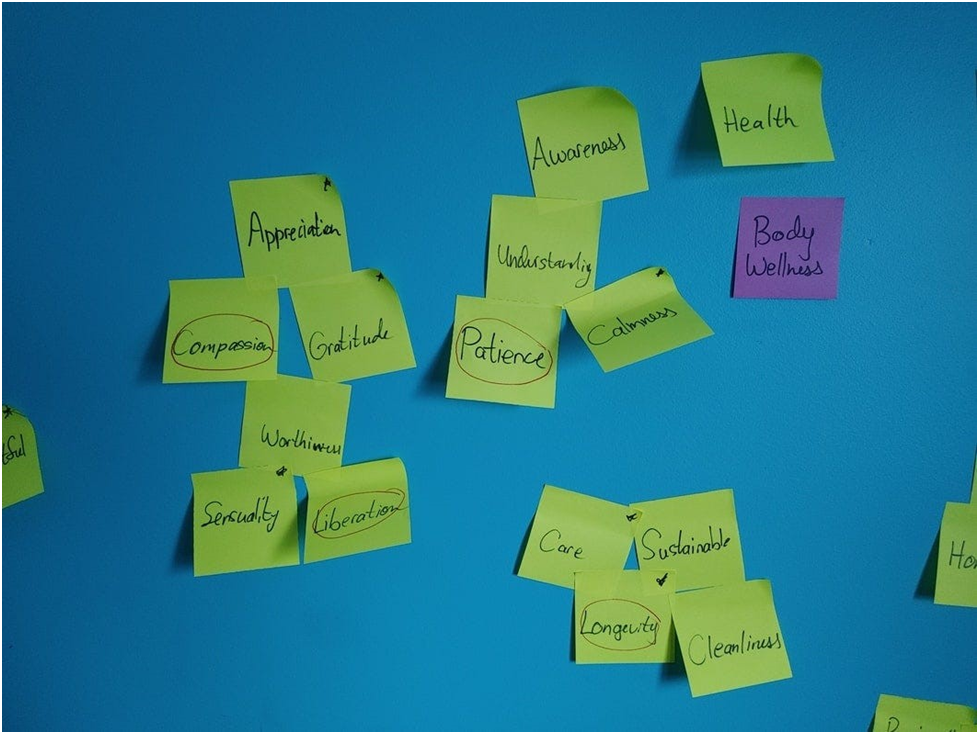
Circle the core values that best represent each of your clusters. These circled core values are your “guiding words”.
Step 8: Reset!
At this point, you’ve exhausted your themes. Let’s hit the reset button and iterate again.
Write “Shortlist” on a highlight colour sticky and place this sticky on a new section of the wall.
Re-transcribe your guiding words onto fresh sticky notes. Add them to your shortlist area. If you had repeating guiding words as I did, note those sticky notes with a star for each time the core value was repeated. These words will be good candidates for your final list of core values.
Why re-transcribe when you can just move your existing guiding word sticky notes over to the shortlist? It’s worthwhile to keep your original guiding words and their supporting clusters as a reference while you zero in on your final set of core values. In moments where you find yourself wondering “wait, where did this word come from?” a quick peek at your original wall can anchor your train of thought.
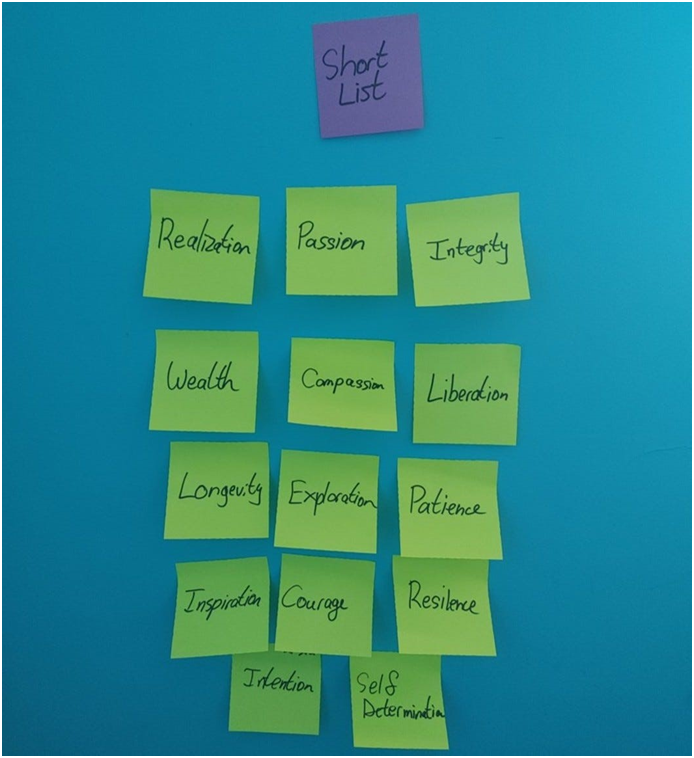
Transcribe your guiding words onto new sticky notes to create your shortlist of core values.
Step 9: Re-Cluster Your Core Values
Cluster these guiding words.
Again, you may have some unclustered core values. All good.
This step demonstrates the magic of iterative design. Even though you’ve been reviewing these specific words in increasing detail since we began, you’ll likely notice how reframing these core values into new clusters can cause these words to take on new meaning. It may also shift your interpretation of these words.
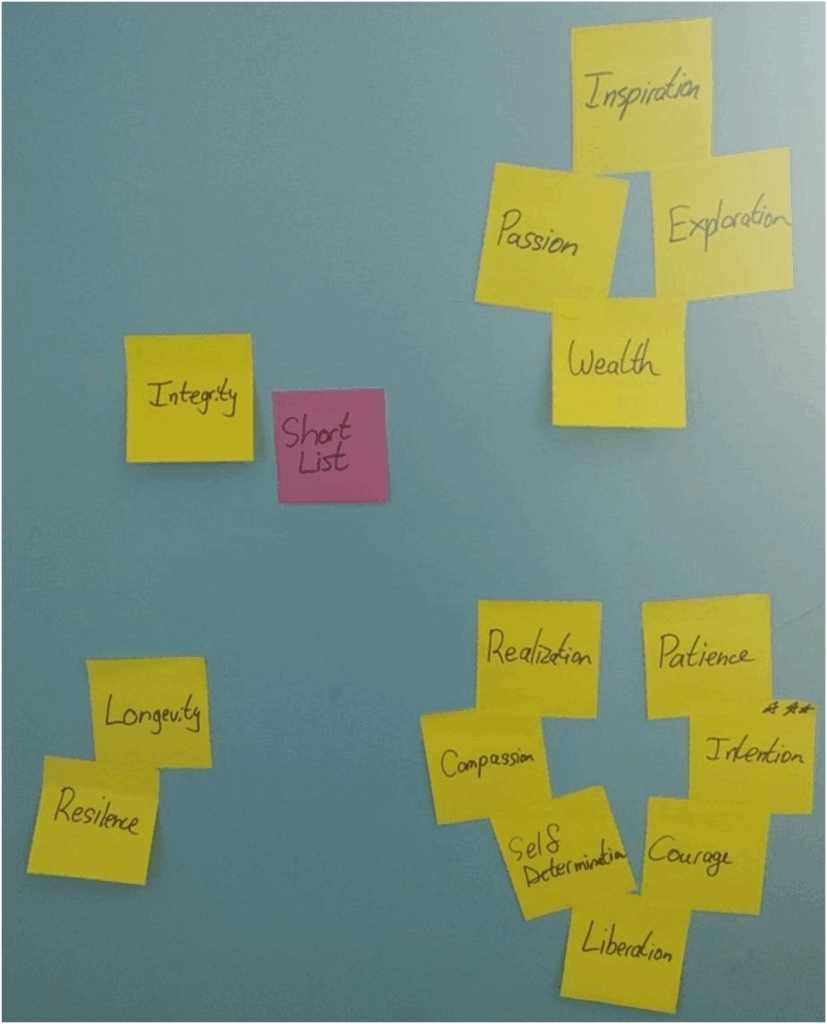
Re-cluster your shortlisted core values.
Step 10: Identify Your Core Values
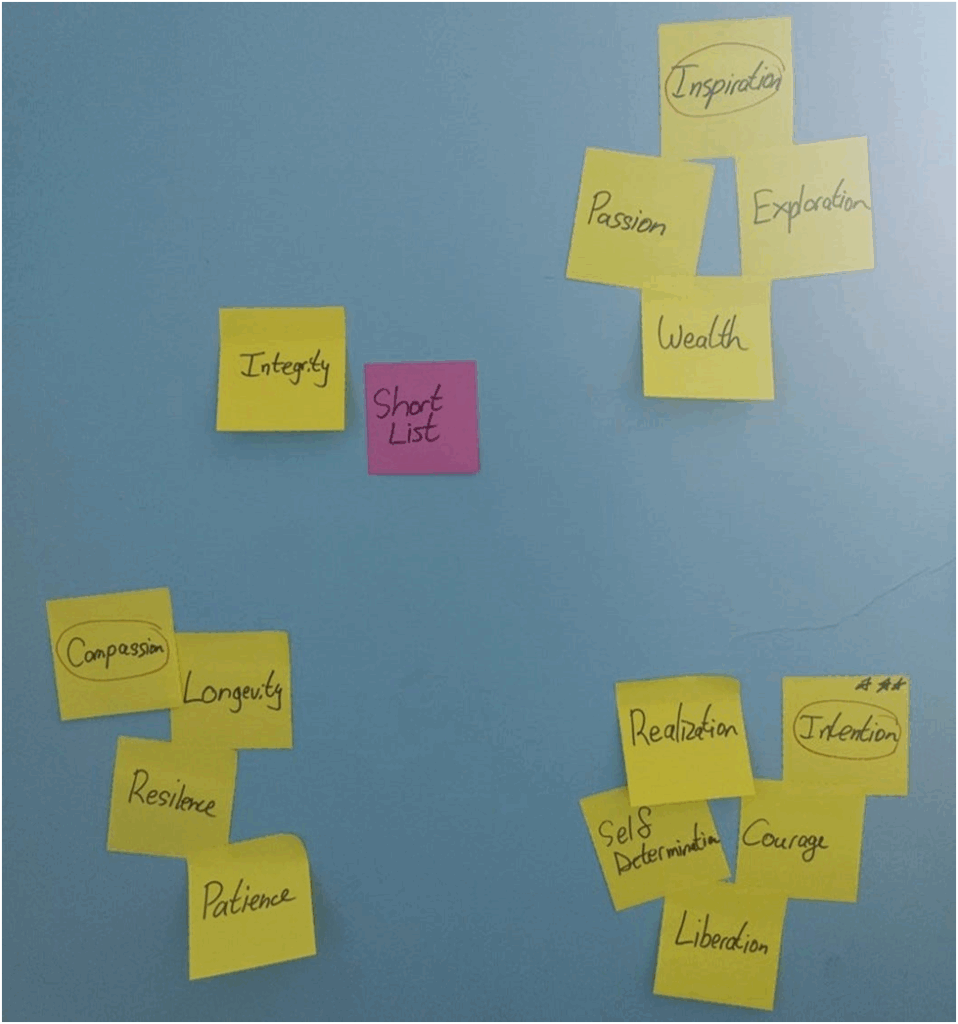
Circle the core values that best represent each of your clusters.
Repeat Step 7’s process of identifying the guiding words per cluster. This time, the words you select will be your final core values (no pressure). Circle these keywords with your highlight colour marker.
If the core values to circle aren’t immediately obvious, try making sentences out of your clusters and pay attention to the core values you naturally emphasize. Frame these sentences as commitments to yourself for how you will act going forward.
For example, I had a cluster with “passion”, “inspiration”, “exploration”, and “wealth”. Trying to use them in a sentence, I came up with the following:
“I will explore my passions to uncover opportunities for inspiration, developing wealth.”
Here, it’s clear exploration and passion are a means to an end. Wealth is a byproduct.
Inspiration is the focus of this cluster.
If keywords aren’t revealing themselves, try re-clustering and re-stating your commitment statements until they work.
The words you circled are your final core values. Congratulations!
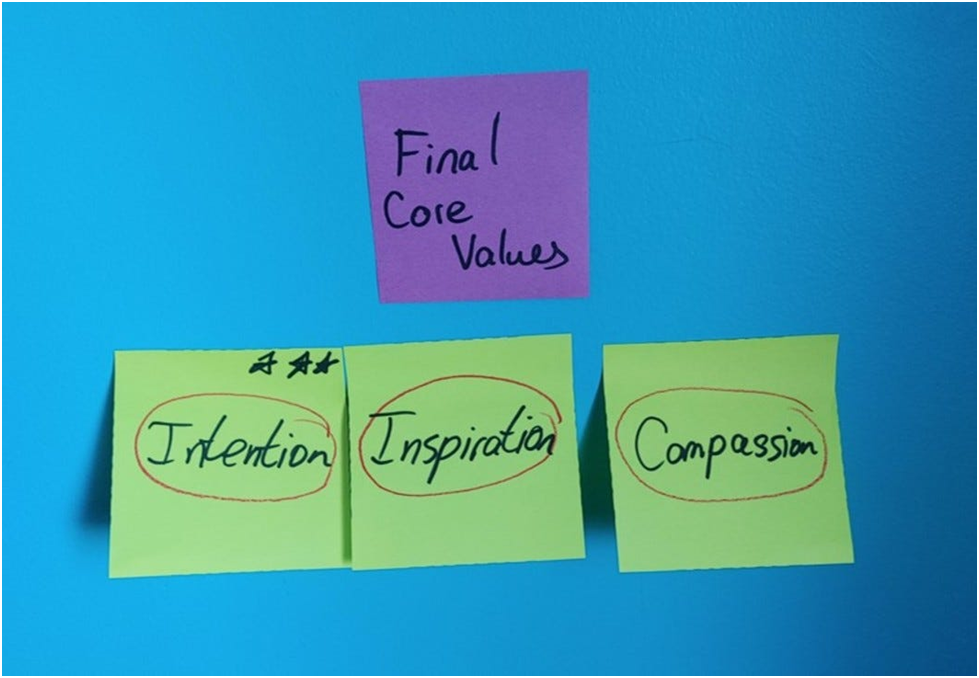
My final set of core values.
Optional Step: Write your Goals
Now that you have your core values, you already hit a major milestone. Optionally, go even further and use your core values to either develop new goals or to validate your pre-existing goals.
To Develop New Goals
You have your core values, now let’s activate them with some tangible, time-bound goals. You may guess, I’m a fan of SMART (Specific, Measurable, Achievable, Relevant, Time-Based) Framework goals.⁸
As you develop your SMART goals, keep your core values in mind. Especially when you hit “Relevant” in the SMART framework, ensure you’re evaluating these goals based on your core values.
To Validate Your Pre-Existing Goals
Take your list of existing goals and consider whether or not they are in service of your core values. To do so, use one of the following question structures:
- Will (goal) enable (core value)?
- Is my goal of (goal) in service of my core value of (core value)?
- Will (goal) allow me to show up with greater/more (core value)?
If the answer is “yes” for at least one of your core values, this goal will serve you well. Better yet, whether or not you fully achieve this goal as stated, be assured that your efforts have brought you closer to alignment with your core values.
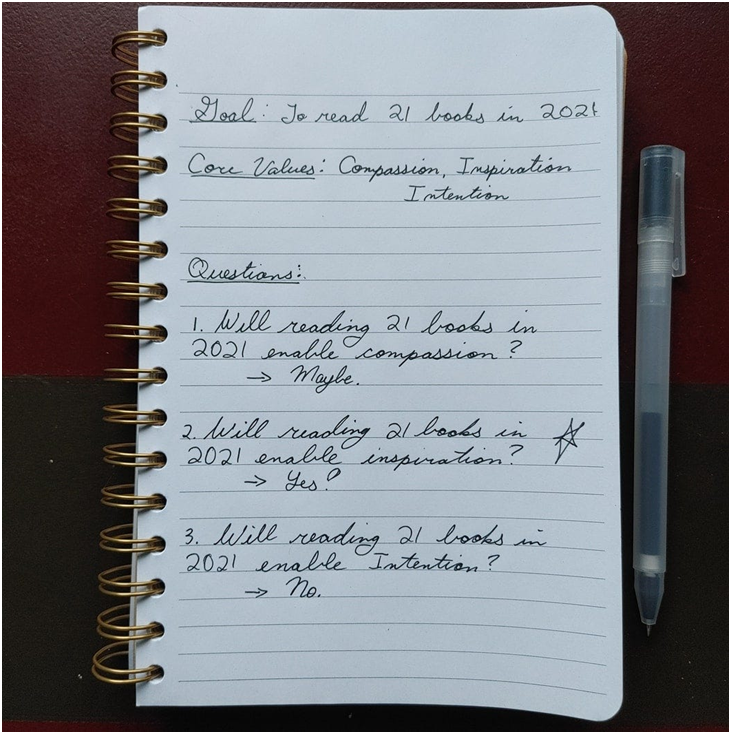
Sample validation of a pre-existing goal against a set of core values.
For example, if your goal is “I want to read 21 books in 2021” and your identified core values are “Compassion”, “Inspiration”, and “Intention”, ask yourself the following questions:
- “Will reading 21 books in 2021 enable compassion?” — Maybe
- “Will reading 21 books in 2021 enable inspiration?” — Yes
- “Will reading 21 books in 2021 enable intentionality?” — No
This goal is in service of inspiration. It passes the test.
If, for any of your goals, the answers to every question were “no” or “maybe” consider how you can adapt these goals to better serve you and your core values.
You’ve made it to the end of the guide. Congratulations x2!
—
Oh, my earlier comment about quality adhesive sticky notes? Here’s proof of why it matters, captured approximately 1 hour after I finished the activity.
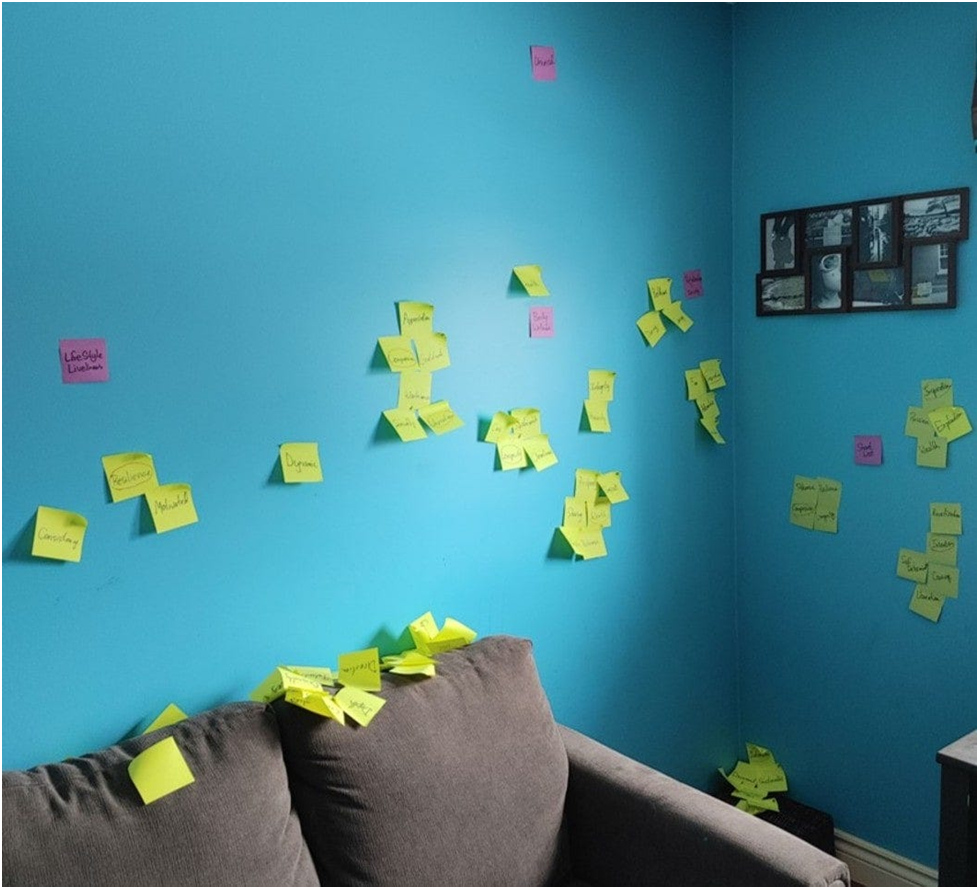
What’s worse than an unsticky sticky note? Approximately 60 of them.
—
Gwenna Kadima (she/her) is an award-winning diversity, equity, and inclusion consultant activating meaningful, systemic workplace transformation. She is the founder and CEO of Center Desk Consulting, a boutique consultancy bringing DEI from “side-of-desk” to center focus through targeted interventions that deliver tangible, lasting results. Supporting clients across the full spectrum of DEI initiatives, Center Desk Consulting specializes in anti-oppressive employee resource group enablement and equitable employee experience design.
—
[1]: Meg Selig. (November 27, 2018). 9 Surprising Superpowers of Knowing Your Core Values. https://www.psychologytoday.com/ca/blog/changepower/201811/9-surprising-superpowers-knowing-your-core-values
[2]: Accenture Recruitment. (January 8, 2019). Why People Are at the Center of Design Thinking. https://www.accenture.com/us-en/blogs/blogs-why-people-are-at-the-center-of-design-thinking
[3]: Courtney Seiter. (September 9, 2018). The 5 Whys Process We Use to Understand the Root of Any Problem. https://buffer.com/resources/5-whys-process/
[4]: Scott Jeffrey. (Accessed January 2, 2021). List of Personal Core Values. https://thehappinessplanner.com/pages/list-of-core-values
[5]: Threads Culture. (Accessed January 2, 2021). Core Values Examples. https://www.threadsculture.com/core-values-examples
[6]: Anna Elizabeth. (Accessed January 2, 2021). productive but chill morning playlist Phttps://open.spotify.com/playlist/7K85YlenlgVlVW2H6hiN21?si=6o8BIEGEQzy4Fpp_nIHOQw
[7]: Danielle LaPorte. (Accessed January 2, 2021). Life Areas Collection. https://www.daniellelaporte.com/life-areas-collection [8]: Chris Bergen. (August 5, 2019). How to Set Better Goals with the ‘S.M.A.R.T. Framework’. https://medium.com/swlh/how-to-set-better-goals-with-the-s-m-a-r-t-framework-e6ae7651a94